
Checking Dauphin County Criminal History
No single search combines every Dauphin County criminal record. Start with the free Unified Judicial System of Pennsylvania Web Portal when the goal is a court docket. Choose Common Pleas for felony and misdemeanor matters held for court, or Magisterial District Court for preliminary, traffic, and summary proceedings. Select Dauphin County and search by docket number or participant name. A same-name result needs confirmation through dates, the court office, charge details, and the docket number.
For a certified local conviction search, write to the Dauphin County Clerk of Courts. The clerk asks for the subject's name, address, date of birth, full Social Security number, and aliases or prior names. That request is not accepted by phone. Use PATCH for a statewide Pennsylvania repository check, and use the separate PSP Access and Review procedure when examining your own complete Pennsylvania record.
- Define whether you need a docket, police report, custody entry, local conviction letter, or statewide record.
- Search UJS with the correct court level and Dauphin County filter when a judicial case is the target.
- Compare identifiers and read the disposition for every count instead of relying on the first charge shown.
- Ask the creating police agency for an incident report or Dauphin County Prison for current county custody.
- Order a Clerk certification, PATCH result, or personal Access and Review when an official product is required.
Three Dauphin Criminal Record Searches
PATCH, UJS, and the Dauphin Clerk answer different questions. UJS is the free place to read public Pennsylvania docket sheets. The Clerk can issue a sealed letter about Dauphin County convictions and supply plain or certified court copies. PATCH searches qualifying statewide history reported to the Pennsylvania State Police Central Repository. None is a substitute for a police narrative, and none provides a live county jail roster.
| Channel | Best use | Main limit |
|---|---|---|
| UJS Web Portal | Public MDJ and Common Pleas dockets | Not a PSP background check |
| Dauphin Clerk | Local conviction letter and court copies | Dauphin matters only; written request |
| PATCH | Official statewide name-based result | No federal or other-state records |
| SP 4-170 | Your own full Pennsylvania review | Subject-only and mail-only |
The Dauphin County government directory shows how the county divides these duties among separate offices.

That department structure explains why a broad request sent to one desk may need rerouting.
Pennsylvania Official Background Checks
The Pennsylvania State Police Bureau of Records and Identification operates PATCH, the Pennsylvania Access To Criminal History system. A nonregistered user may order a standard name-based check for $22. Optional notarization adds $5. Eligible volunteer checks are free but cannot be notarized. Ordinary users pay online by Visa, Mastercard, Discover, or American Express, and may submit up to ten checks in a session.
A standard PATCH result is not the same as personal Access and Review. Form SP 4-170 costs $20, travels by mail, and returns the subject's Pennsylvania convictions and non-convictions. That fuller route is better for checking your own record, preparing a correction, or assessing expungement. For authorized FBI fingerprint checks, Pennsylvania uses IDEMIA/IdentoGO. Preregistration is required, fees vary by service code, and the official location tool should be checked for current sites and hours.
The PSP criminal-history request page sets out the official products and current process.
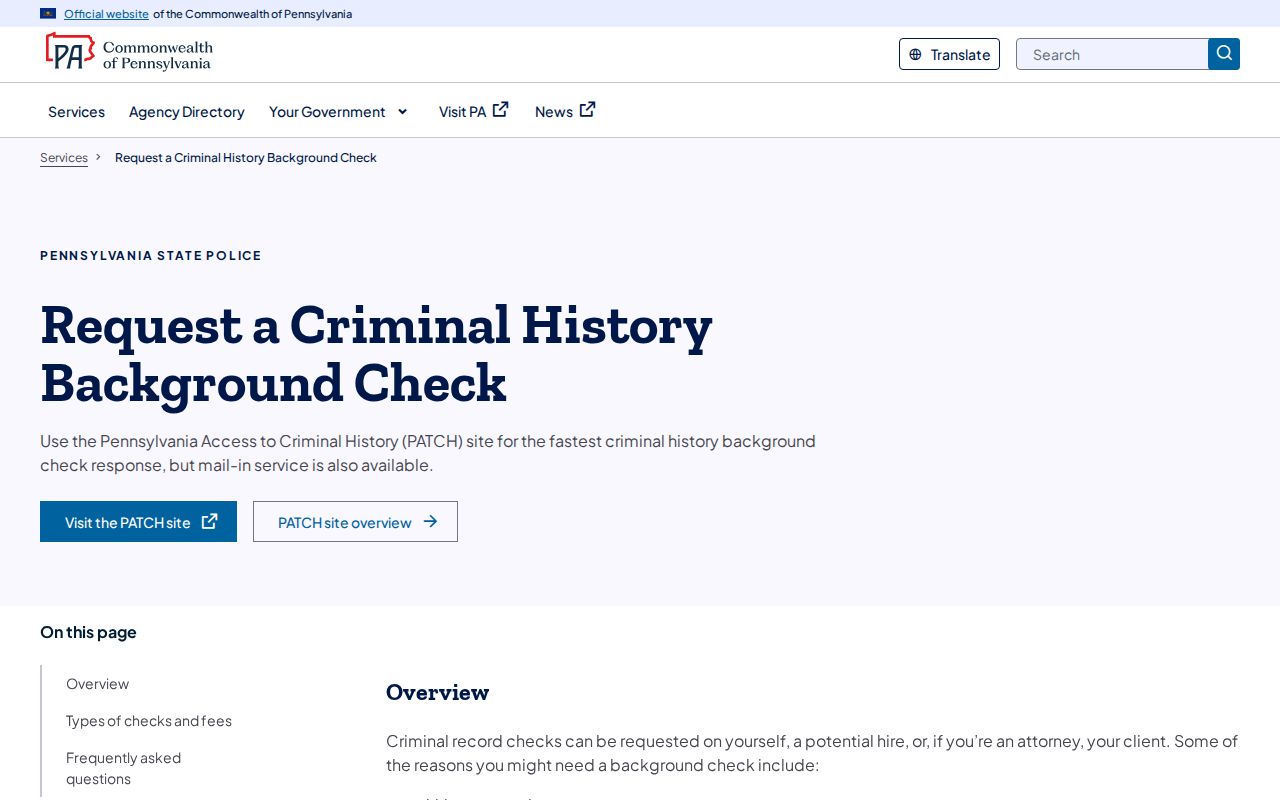
This state guidance is the right checkpoint before paying for a Pennsylvania repository result.
PATCH Fields for Dauphin Records
A PATCH session begins with requester contact details, then asks for the subject's name and marked identifiers. Accurate spelling matters. Add aliases where the form permits them. An email address is optional but useful because it can carry the receipt and result-ready notice. Save the assigned control number after payment.
| Requester details | Name and address are required for a nonregistered session. |
|---|---|
| Subject details | Name is required; identifiers and dates follow the form's marked fields. |
| Status retrieval | Control number, exact subject name, and original request date. |
| Payment | Card details for a paid online check. |
| Result | View and print the certification form from the requester's computer. |
The official PATCH portal provides both a new-record-check path and a status-check path.
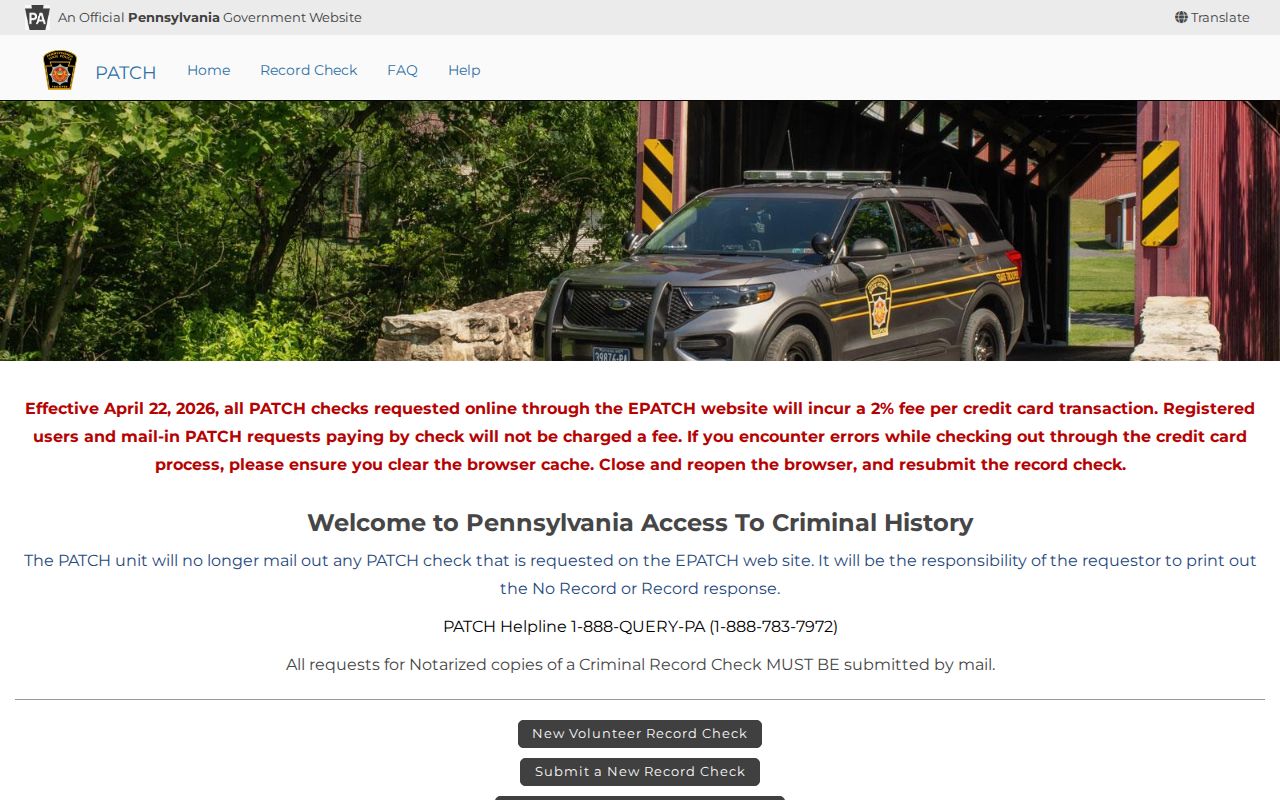
A status of “Under Review” means PSP found identifiers needing manual review. It does not, by itself, mean a record exists, and review may take two to four weeks.
Criminal Record Types
Dauphin County criminal records describe different stages of one event. Police create an incident or arrest report. Dauphin County Prison creates a booking and custody entry. A Magisterial District Judge records preliminary proceedings, bail, traffic matters, and summary cases. Once charges are held for court, the Dauphin County Clerk of Courts maintains the Court of Common Pleas file.
PSP assembles qualifying fingerprinted arrests and reported outcomes in its Central Repository. The UJS docket may show a warrant event, but research found no comprehensive official Dauphin County public warrant-name database. Probation and parole dockets can show sentence or violation events, yet supervision notes are not a general public file.
- Police report: the event narrative, officers, alleged conduct, evidence, and initial charges.
- Booking record: admission, agency, custody status, charges, bail, and release details.
- Court docket: filed counts, hearings, motions, pleas, outcome, sentence, and financial obligations.
- Repository history: fingerprint-linked arrest cycles, dispositions, and qualifying statewide data.
- Registry or supervision record: a distinct legal status with its own access rules and limits.
Dauphin Criminal Custody Locators
Use the Dauphin County Prison “Inmate Look Up” route for current county custody. The prison at 501 Mall Road in Harrisburg can also be reached at 717-780-6800. A county booking is not a finding of guilt. It can appear before the court docket is indexed, and its initial charges can later be withdrawn, reduced, consolidated, or replaced.
Use the Pennsylvania Department of Corrections Inmate/Parolee Locator after a person enters state custody or state parole. PA DOC updates the locator daily and expressly excludes county-prison prisoners. Search by inmate number when known, or begin with last name for the broadest name search. PA SAVIN offers qualifying custody and release notices, but an alert does not replace the current docket or official office confirmation.
The PA DOC Inmate/Parolee Locator displays the state search route. Choosing county prison or state corrections first prevents a false “no result” caused by searching the wrong custody system.
Inside a Dauphin County Criminal Record
A repository history usually starts with an identification segment, including names, aliases, date of birth, and fingerprint-linked identifiers. Arrest cycles then list dates, agencies, charges, and tracking data. Reported dispositions, sentences, and custody or supervision entries may follow. A public display should not expose full Social Security numbers, financial accounts, or other protected identifiers.
A docket is organized around one court case, not a person's whole history. Read the docket number, court, count, statute, grade, filing date, bail, disposition, sentence, and costs together. A booking record is narrower still. It emphasizes admission, booking number, arresting agency, holding status, charges, bond, housing, and release information.
- Disposition
- The outcome of a charge or proceeding.
- ARD
- Accelerated Rehabilitative Disposition, a Pennsylvania pretrial diversion path that may support later expungement after successful completion.
- Nolle prosequi
- A prosecutor's formal decision not to proceed on a charge, subject to court process.
- Limited access
- A Pennsylvania order that restricts public dissemination of qualifying records without treating them as destroyed.
Dauphin Criminal Records at Front and Market
The Dauphin County Courthouse at 101 Market Street in Harrisburg houses the Clerk of Courts criminal counter and the Court of Common Pleas. Two public terminals in the Clerk's office let visitors conduct their own searches. The clerk keeps Common Pleas Criminal Division records, provides copies, and can return an official sealed search letter by mail. Staff cannot give legal advice and do not provide record information by telephone.
The courthouse is not the county prison or Administration Building. Current custody belongs at Mall Road. The Public Defender is at 2 South 2nd Street, while Adult Probation Services is at 917 Gibson Boulevard in Steelton. The old Pennsylvania label “row officer” helps explain the split: elected record keepers once occupied a literal row of courthouse offices, and their separate duties survived as county government grew.
Dauphin Clerk of Courts
101 Market Street, Harrisburg, PA 17101
Common Pleas files, public terminals, copies, and certifications.
Dauphin County Prison
501 Mall Road, Harrisburg, PA 17111
Current county custody and inmate lookup.
Adult Probation Services
917 Gibson Boulevard, Steelton, PA 17113
County court supervision; 717-780-6900.
Public Access Laws in Pennsylvania
The Pennsylvania Right-to-Know Law permits specific requests to public agencies, but it preserves exemptions. It does not force release of active investigative files, protected victim or juvenile facts, or sealed material. Court case records follow the Unified Judicial System access policy. Police audio and video follow a separate Act 22 process, not the routine RTKL form.
Route the request by record owner. Send county administrative requests to the Dauphin County Office of Open Records. Use the designated District Attorney process for law-enforcement records and appeals. Ask the creating municipal police department for its reports. Use UJS or the Clerk for judicial records.
Key Pennsylvania authorities:
65 P.S. § 67.701 et seq. permits specific agency requests while keeping statutory exemptions.
18 Pa.C.S. § 9121 governs the collection, maintenance, completeness, and release of criminal-history data.
18 Pa.C.S. § 9122 authorizes expungement in qualifying circumstances.
18 Pa.C.S. § 9122.1 creates an order for limited access to qualifying records.
UJS Public Access Policy controls access and redaction for Pennsylvania court case records.
The Dauphin County public-records hub identifies the county request route and forms.
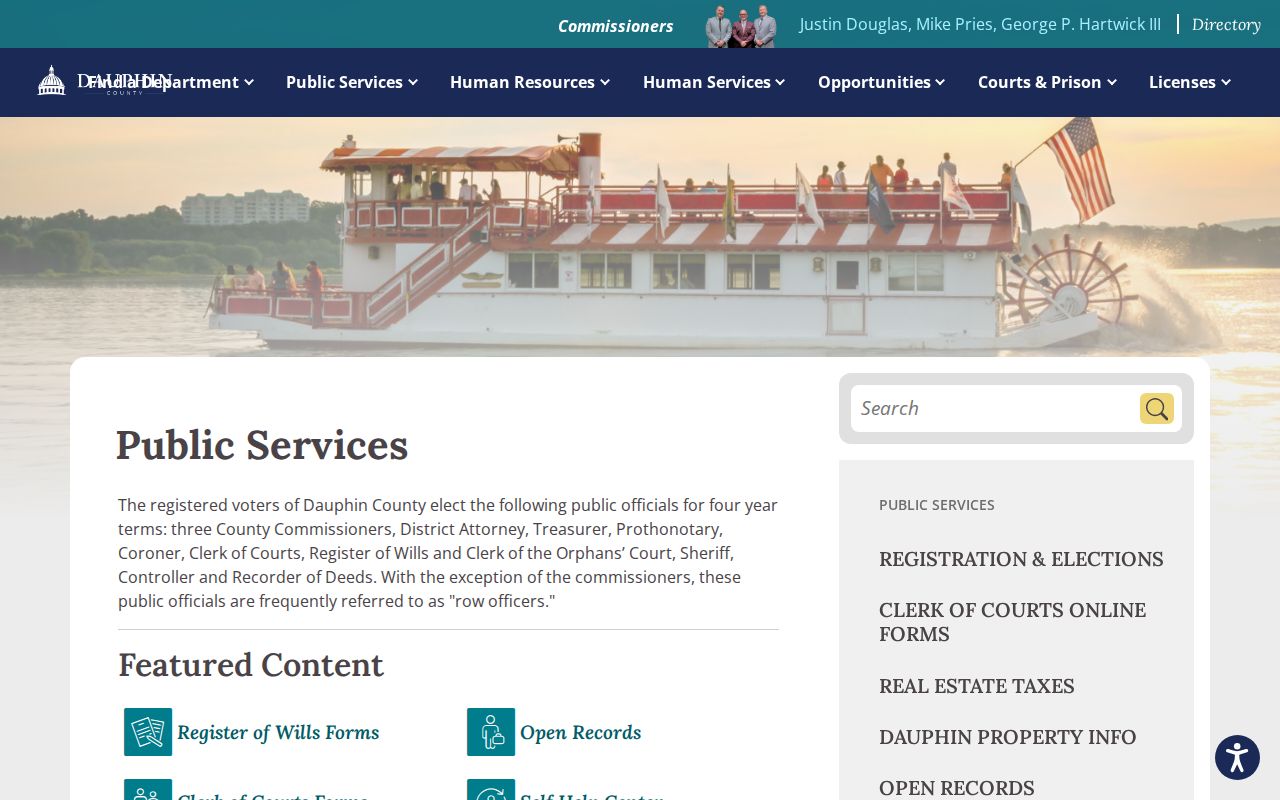
That route works for county agency records, while court dockets and police recordings remain subject to their distinct rules.
Dauphin Criminal Record Fees Compared
Price alone does not show which product is broader. The Clerk's local search and PATCH's statewide check have different scope. The current Clerk schedule controls when an older FAQ lists a conflicting figure. Confirm a total before mailing payment, especially when copies, certification, redaction, postage, or a new docket are involved.
| Product | Published charge | Scope |
|---|---|---|
| PATCH standard | $22 | Pennsylvania name-based repository check |
| PATCH notarization | $5 add-on | Eligible standard result |
| PSP Access and Review | $20 | Your own convictions and non-convictions |
| Dauphin Clerk search | $12 plus applicable $5 automation fee | Dauphin conviction search letter |
| Plain Clerk copy | $0.50 per page | Local court file pages |
| Certified Clerk copy | $12 current schedule | Certified local court copy |
Sealed, Expunged, and Restricted Records
Pennsylvania distinguishes expungement from limited access. Expungement removes qualifying criminal-history information under 18 Pa.C.S. § 9122 and court rules. Limited access restricts public dissemination while preserving access for authorized criminal-justice purposes. Automatic Clean Slate processing provides another statutory route. Juvenile files, sealed matters, victim or minor details, financial accounts, and records closed by court order are not ordinary public content.
Dauphin's expungement packet calls for a current PSP criminal record, the docket transcript and disposition, proof that costs are paid, and the proper petition and order. Eligibility turns on the actual charge and outcome. A dismissal does not always vanish on its own, and most convictions cannot simply be erased. Successful ARD, listed non-convictions, some summary matters, narrow age or death provisions, and a later pardon may create routes in defined cases.
The Pennsylvania criminal-history chapter contains the governing expungement and limited-access provisions.
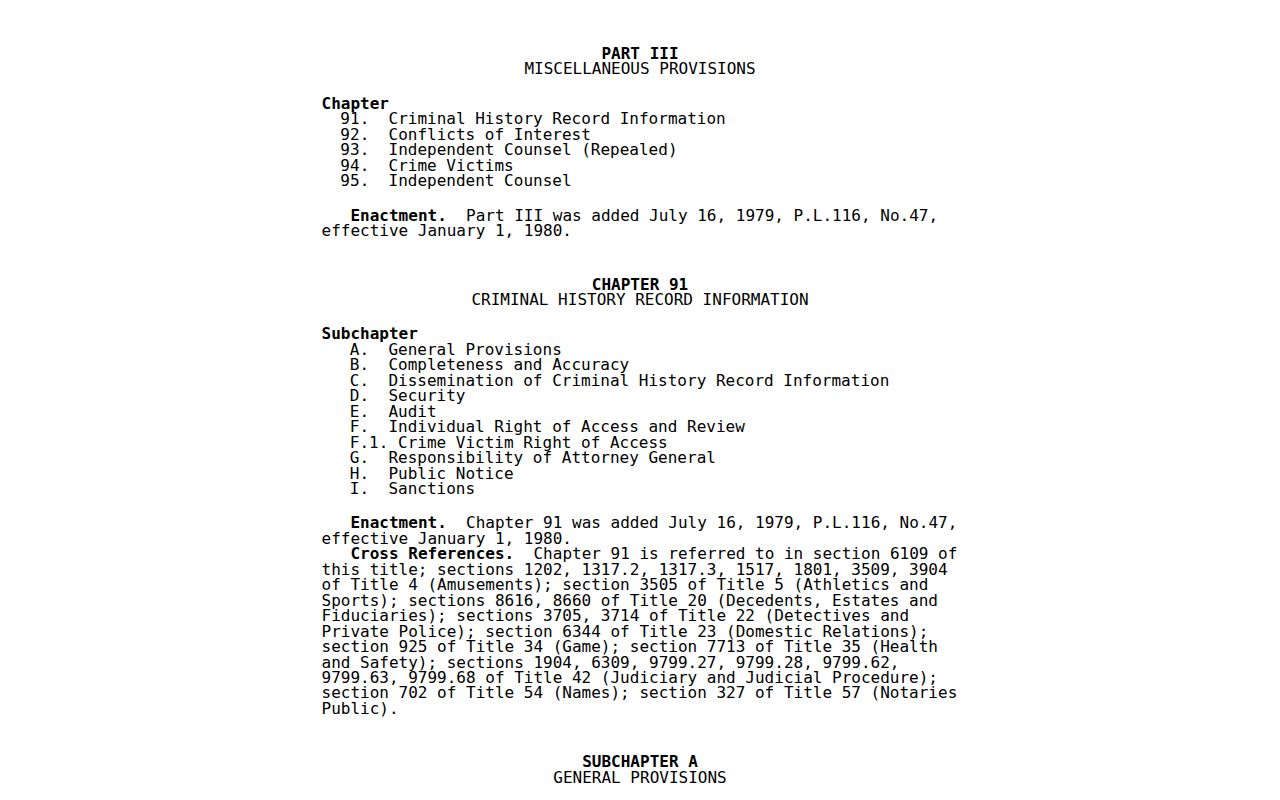
After an order is granted, keep a certified copy. The Clerk warns that cleanup across repositories can take up to twelve months, so check UJS and a PSP Access and Review later.
Dauphin Fingerprint Record Routes
Name searches and fingerprint checks are not interchangeable. PATCH compares submitted identifying data with the PSP repository. An authorized FBI check uses fingerprints captured through IDEMIA/IdentoGO under the correct service code. Preregister first, then search official locations and hours. Appointments are encouraged, though a preregistered person may use a site during operating hours. IDEMIA help is available at 1-844-321-2101.
The FBI Identity History Summary is subject-only. A person can order through the FBI's electronic process, submit fingerprints, and pay the current federal fee shown there. It differs from a local Dauphin docket and from PATCH because it reflects FBI-maintained history linked to the submitted prints.
The IdentoGO enrollment and location tool supplies current program-specific fingerprint options.
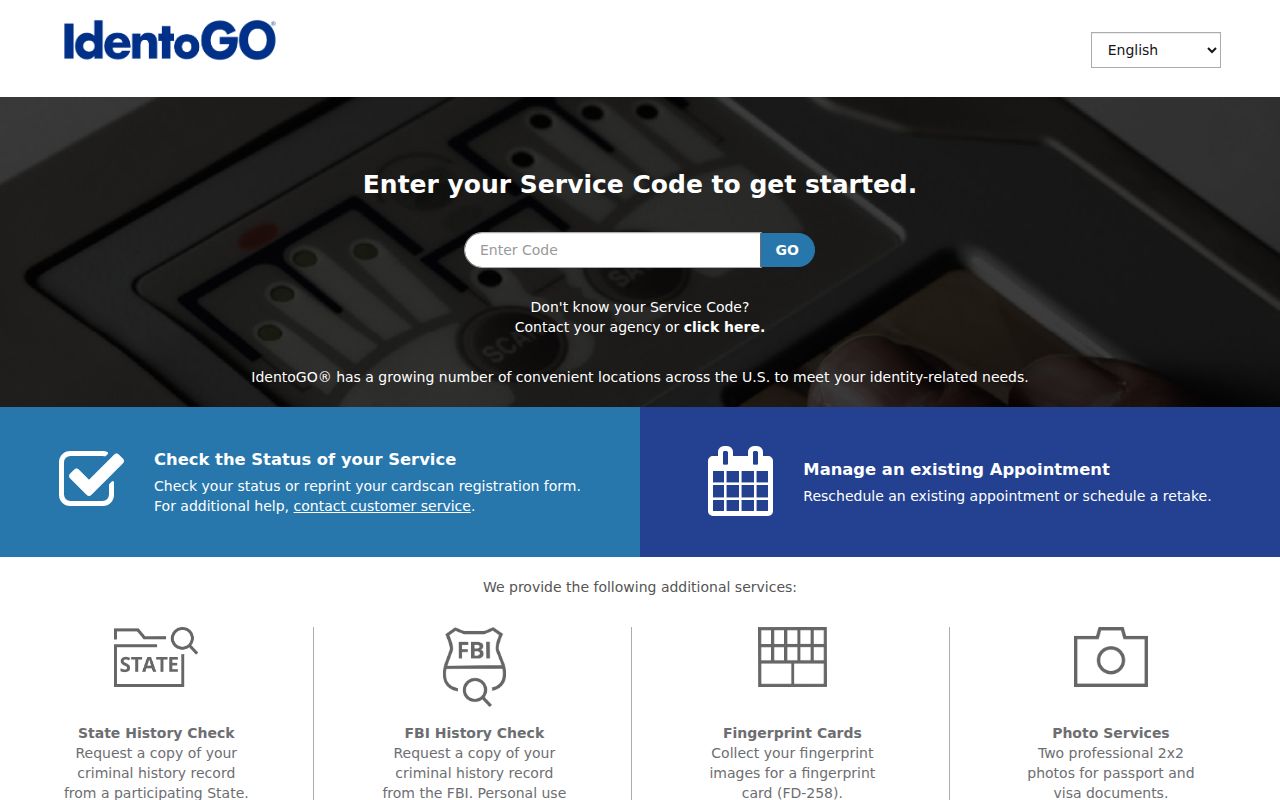
The live location tool is more reliable than publishing a fixed store list that may soon change.
The FBI electronic ordering portal starts a subject-only Identity History Summary request.
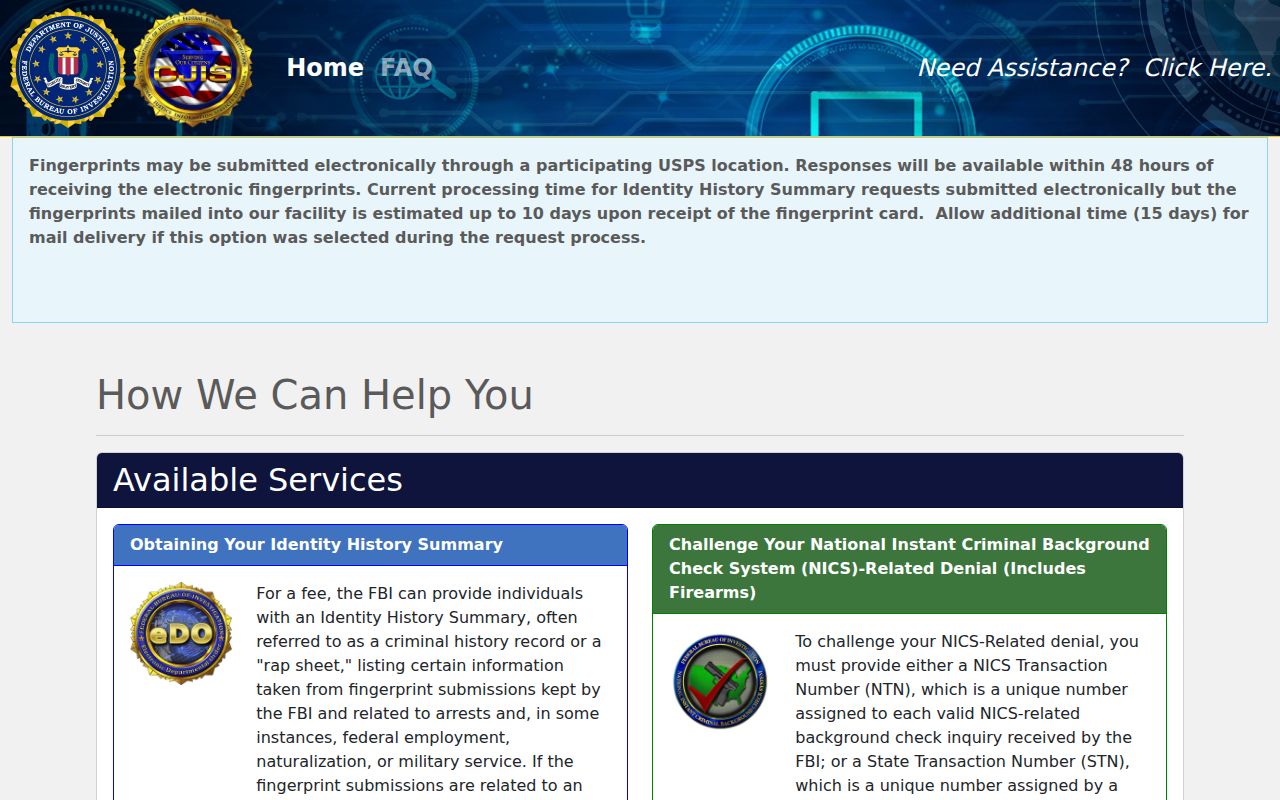
This federal route should be used only for the requester's own FBI history and not confused with a county case search.
Dauphin County Criminal Records by City
Police reports remain with the department that created them. Harrisburg directs requests through its Police Records Center and city Right-to-Know process. Lower Paxton Police Records operates from the municipal center and publishes its own fee policy. Derry Township uses separate general RTKL and Act 22 recording forms. Court cases from all three locations move through the assigned Magisterial District Judge and, when held for court, to Dauphin Common Pleas.
Harrisburg Criminal Records
City police reports start with the Records Center at 123 Walnut Street.
Lower Paxton Criminal Records
Police records route through the lower level at 425 Prince Street.
Derry Township Criminal Records
Police and township records use distinct Clearwater Road offices and forms.
Dauphin Warrants and Police Records
No verified official countywide public warrant-name database was found. Check UJS for docket events, then contact the issuing Magisterial District Judge or Clerk. A bench warrant often follows a missed appearance or court-order issue. An arrest warrant follows a complaint and probable-cause process. Search warrants may remain nonpublic while pending. A recalled warrant can also linger in one system, so seek confirmation from the issuing court.
For police narratives, contact the arresting department. Harrisburg, Lower Paxton, and Derry each use its own request route. County administrative requests may go to openrecords@dauphincounty.gov, while law-enforcement requests to the District Attorney must use the designated county form. A docket shows court action, not the officer's report. The Dauphin County criminal court cases page explains how filed charges and dispositions move through the local courts.