
Dauphin County Criminal Court Cases
Dauphin County criminal court cases begin at one of the county's Magisterial District Courts. An MDJ conducts the preliminary arraignment, addresses bail, and holds a preliminary hearing. Summary, traffic, and non-traffic cases may remain at that level. When felony or misdemeanor charges are held for court, the case moves to the Dauphin County Court of Common Pleas. The District Attorney may then file an information, which is the formal charging document used at Common Pleas.
The Dauphin County Clerk of Courts is the custodian for Common Pleas Criminal Division files. Its office is at 101 Market Street in Harrisburg. Paper MDJ records remain with the relevant district office. This split matters: the Clerk cannot supply a district court paper file that never moved to Common Pleas, while an MDJ office is not the custodian of the later Common Pleas record.
Choose the Dauphin Court Level
A searcher who starts on the wrong UJS tab may conclude that no Dauphin County criminal case exists. Use the MDJ search for a preliminary criminal docket, bail set at the early stage, or a summary matter. Use Common Pleas for a felony or misdemeanor held for court. The official Dauphin County MDJ directory identifies the district offices that keep their own paper records.
The court level also explains why docket numbers change. A matter can have an MDJ docket and a linked Common Pleas docket. Appeals create another docket. Compare cross-references, filing dates, the originating court, and the listed counts before deciding that two entries concern different cases.
The county's official court directory shows how this local two-level system is organized.
View the source for the Dauphin County Magisterial District Judge directory.
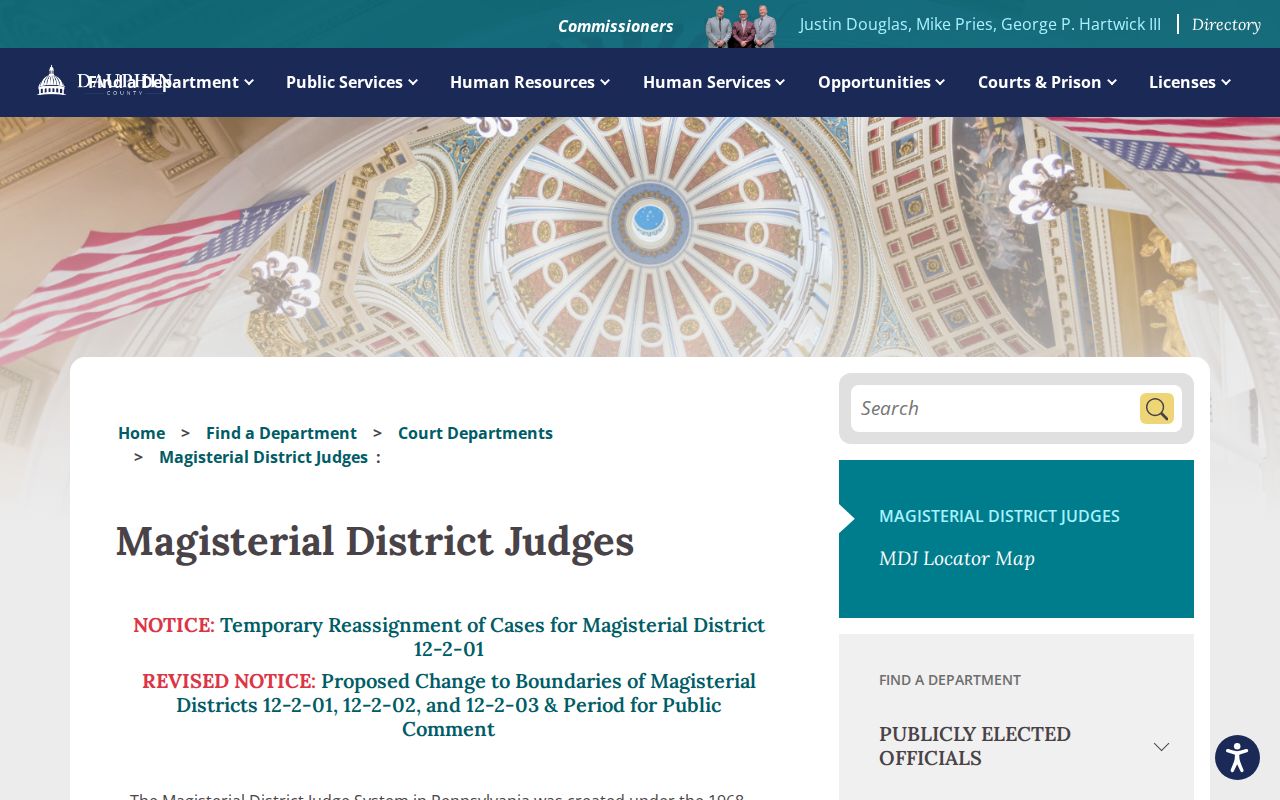
The directory points readers to the office that holds a preliminary or summary case record.
Searching Dauphin County Case Records
The free UJS Web Portal Case Search covers Pennsylvania appellate courts, Courts of Common Pleas, and Magisterial District Courts. A docket number is the strongest starting key. Name searches can work, but spelling variants and shared names call for extra checks. UJS is a docket tool, not a Pennsylvania State Police criminal-history certificate.
- Open Case Search and select Common Pleas or Magisterial District Court based on the stage and charge level.
- Select Dauphin County, then enter the docket number when known. Otherwise use the participant or name fields shown on that tab.
- Compare the court office, docket format, filing date, and public charge details to distinguish people with similar names.
- Open the docket sheet. Read each count, its disposition, bail, docket events, sentence, and financial sections.
- Ask the Clerk or the proper MDJ office for a complete file, paper copy, or certified record when the public docket is not enough.
| Field Label | Type | Required | Notes |
|---|---|---|---|
| Docket number | Text | One search route | Best unique key when available |
| Participant or name | Text | Alternate route | Try supported spelling variants |
| County | Select | Yes for local results | Choose Dauphin County |
| Court level | Search tab | Yes | Common Pleas or MDJ |
| Filing and case details | Result filters | No | Use to verify the intended matter |
Dauphin Clerk Copies and Terminals
Online access is only one channel. The Clerk provides public terminals for self-search at the courthouse and accepts requests for copies or certifications. The Clerk does not perform record searches by phone. For an official Dauphin conviction search letter, the request must be written and include the identifying information listed in the county instructions, aliases, and the required certified payment. That letter covers Dauphin County convictions, not a full statewide history.
The current Clerk fee schedule lists a $12 record check plus the applicable $5 automation fee, plain copies at $0.50 per page, and a $12 certified copy. Redaction when ordering a criminal file is listed at $2 per page plus the copy charge. Confirm the total before ordering because the older FAQ contains a prior search price.
Dauphin County Clerk of Courts
101 Market Street
Harrisburg, PA 17101
Criminal Division file custodian
Public terminals and copy requests
The Clerk's source page shows the local criminal record office.
View the source for the Dauphin County Clerk of Courts.
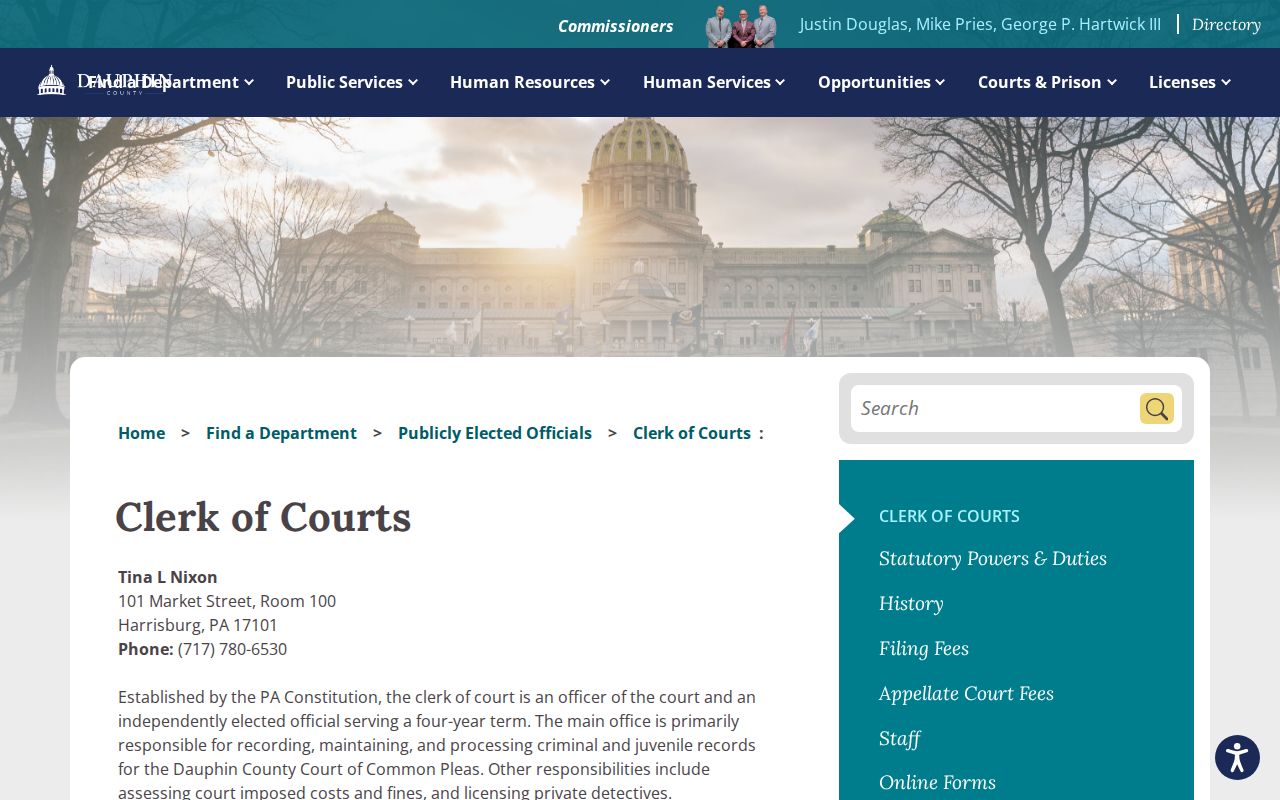
This office, rather than the Sheriff, maintains the Common Pleas criminal case file.
Inside a Dauphin County Case File
A Dauphin County criminal case file is arranged around one judicial matter. It can show how the initial complaint became formal counts, what the court scheduled, how each count ended, and what sentence followed a conviction. Public docket sheets summarize much of this sequence, while the courthouse file may contain documents that are not exposed as downloadable attachments.
| Case number and court | Docket identifier, county, court level, status, and commencement date |
|---|---|
| Charging document | Complaint or Common Pleas information with counts, statutes, and grades |
| Docket entries | Filed documents, event dates, filer, judge, and court action |
| Hearings and bail | Preliminary events, arraignment, conferences, motions, bail type, and status |
| Disposition | Outcome recorded separately for each charge, including dismissal, plea, verdict, or withdrawal |
| Sentence and finances | Confinement or probation, concurrent or consecutive terms, fines, costs, and restitution |
Read Dauphin Dispositions Count by Count
Do not stop at the first charge description. A complaint lists allegations at an early point, while the District Attorney may amend or withdraw counts before the case ends. Each row has its own result. A disposition is the outcome of that count. Nolle prosequi means the prosecutor formally chose not to proceed, subject to court procedure. An acquittal is a not-guilty decision. A dismissal ends the count without a conviction. A guilty or no-contest plea can support a conviction and sentence.
Dauphin County dockets may also show ARD, Pennsylvania's Accelerated Rehabilitative Disposition program. Successful completion can support later expungement where authorized, but it should not be relabeled as a conviction or treated as if the public file vanishes at once. When the outcome matters, compare the disposition, sentence, and latest docket entries instead of relying on the first-page charge list.
The UJS portal image below shows the official statewide entry point.
View the source for UJS Case Search.
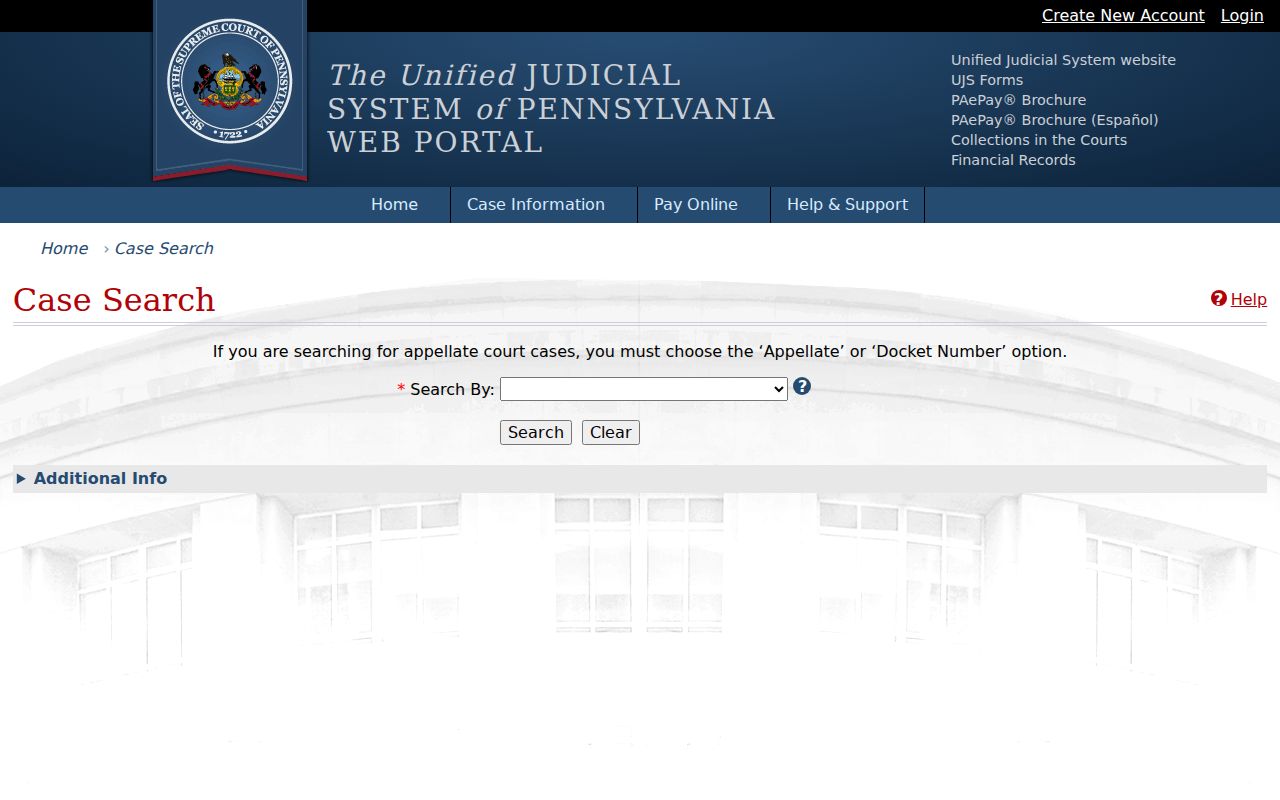
Its separate court tabs make the court-level choice part of every sound search.
Dauphin County Criminal Case Stages
A police complaint or lawful warrantless arrest starts the path. The MDJ conducts preliminary arraignment and sets bail. At a preliminary hearing, the Commonwealth must show a prima facie case before charges are held for Common Pleas. The Dauphin County District Attorney then files an information. Formal arraignment, discovery, conferences, and pretrial motions follow. A case may end through withdrawal, dismissal, diversion, a negotiated or open plea, or trial. A conviction leads to sentencing, and an appeal creates a separate appellate docket.
Case flow: Charges Filed › Arraignment › Pretrial › Plea or Trial › Disposition › Sentencing
The official court page identifies the Common Pleas judges and courthouse setting for these later stages.
View the source for Dauphin County Common Pleas courts.
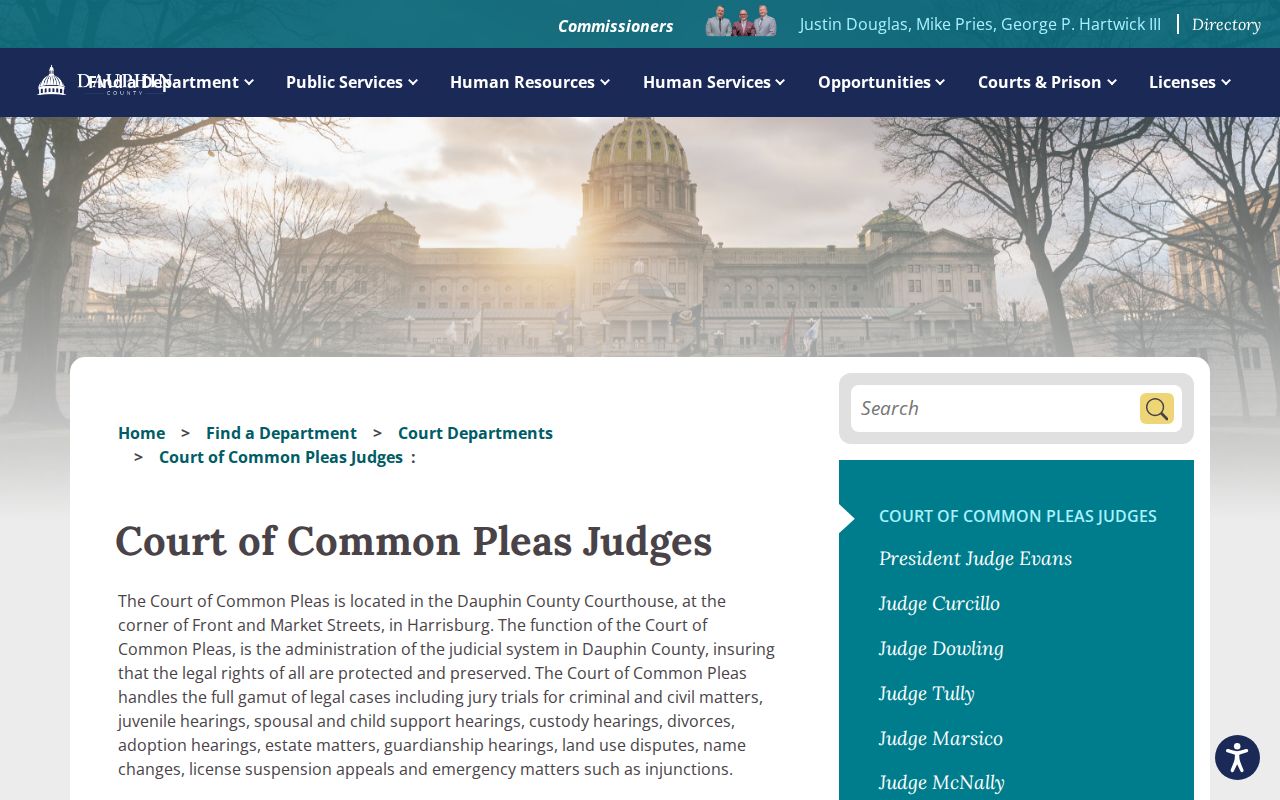
The directory helps distinguish court administration from the Clerk's role as file custodian.
When a Dauphin Docket Is Missing
A missing search result does not prove that no case exists. Check whether the matter is still at the MDJ level, try a supported name variant, and verify the county. A new filing may not yet be indexed. Older paper material or a document not available online may require the Clerk's terminals or a request to the correct MDJ office. Sealed and restricted records will not become public because a searcher asks for them.
For a complete file, contact the custodian. For a certified outcome, request a certified copy. For a statewide criminal-history product, use PSP PATCH instead of treating UJS as a substitute. If the goal is to understand how the case followed an arrest, the Dauphin County arrest lookup explains the separate police and booking records that precede the docket.
Note: A public docket can confirm a court outcome, but it does not reproduce every police narrative or protected filing.
Access to Dauphin County Court Records
The Unified Judicial System Case Records Public Access Policy controls access and redaction for judicial files. It is distinct from the Pennsylvania Right-to-Know Law process used for many executive agency records. Public displays omit Social Security numbers, financial account data, and protected victim, minor, or juvenile information. Sealed matters and documents restricted by law or court order are not ordinary public records.
Online access can be narrower than access to a paper file, yet the courthouse file is not automatically unredacted. Ask the Clerk what can be inspected or copied and identify the docket precisely. The official court case information page also explains free docket coverage and paper-record requests. Pennsylvania CHRIA governs criminal-history collection and dissemination, but a judicial docket remains its own record type.
The fee page image supplies the current local schedule used for copies and searches.
View the source for Dauphin Clerk filing fees.
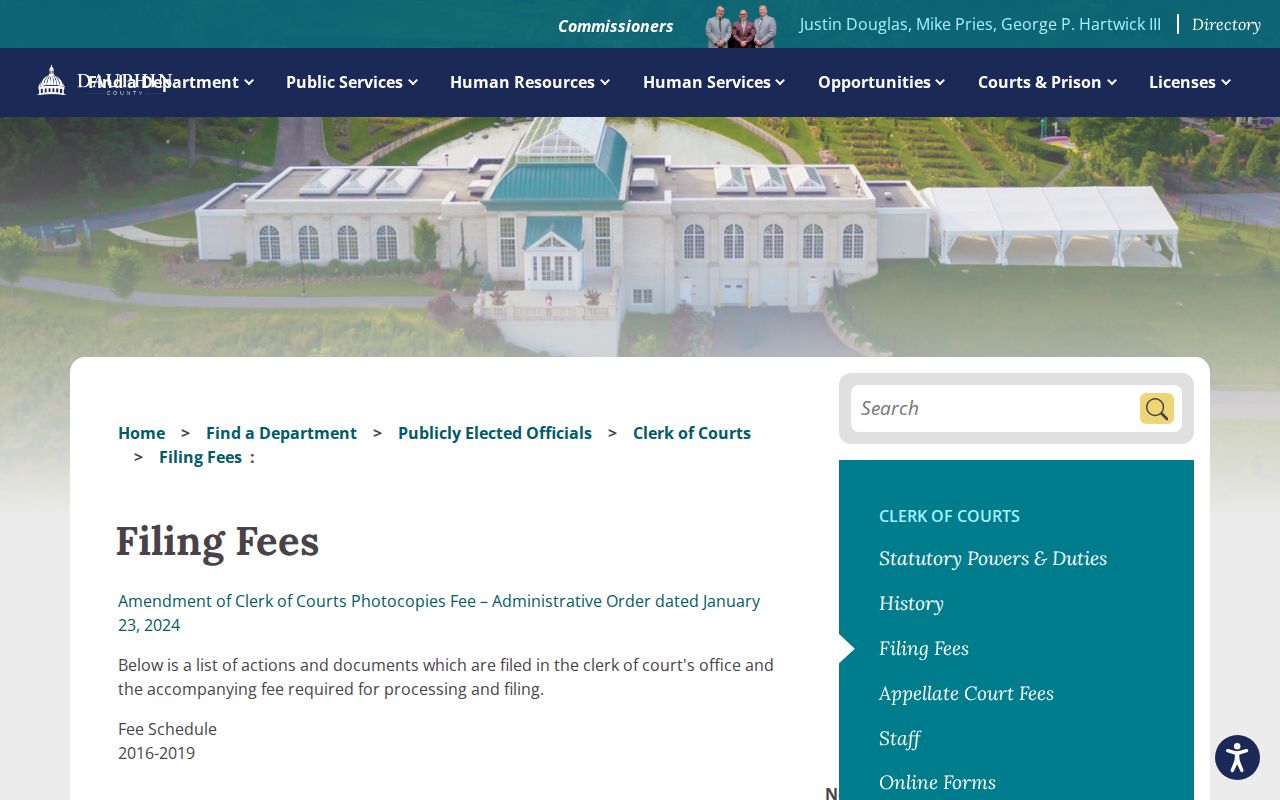
Checking the current schedule avoids relying on the older amount still shown in the county FAQ.
Dauphin Court Terminal Instructions
The Clerk's FAQ confirms that public terminals are available for self-directed record searches. This is useful when UJS identifies the case but does not expose the document needed. Bring the docket number and ask about inspection, a plain copy, or a certified copy. A clerk certification attests to the copied court record; it does not turn a county-only file into a statewide PSP history.
The county FAQ also separates local search letters from public-terminal work and explains that phone searches are not offered.
View the source for Dauphin Clerk record-search instructions.
That local guidance completes the search path when a web docket alone cannot answer the question.